Diode vs CO2 vs fiber: what each laser can cut
The same material can absorb one laser and ignore another. Switch the laser below and watch what happens to clear acrylic, wood and steel — then check any material in the full table, with sources.
One beam, three materials
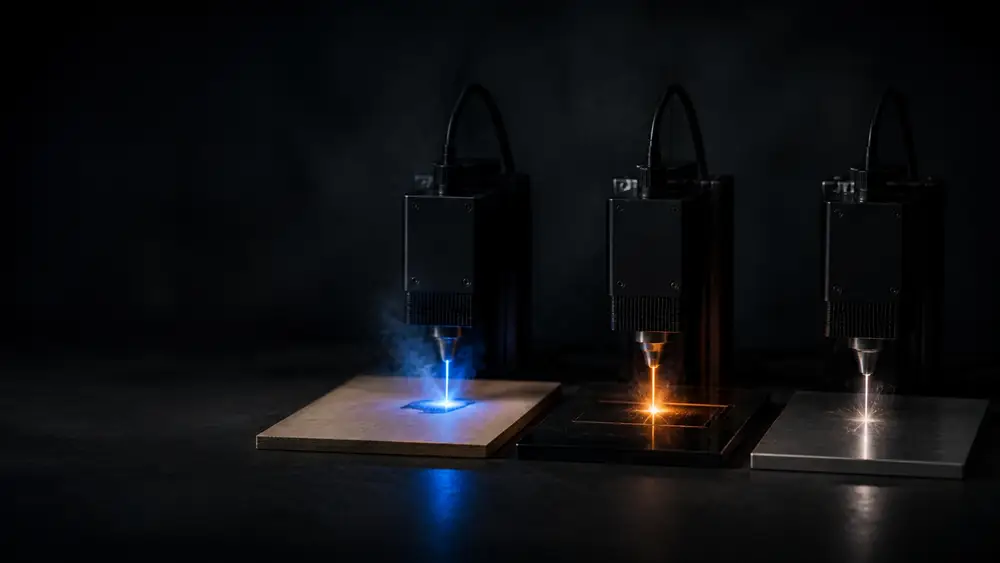
Pick a laser. Clear acrylic lets blue and near-infrared light straight through but swallows the CO2 beam; bare steel throws the CO2 beam back but takes a mark from a fiber laser.
Infrared is invisible; drawn in color here.
Why the laser type matters
A laser only cuts or marks what absorbs its light. Blue diodes sit at about 450 nm, fiber lasers at about 1,064 nm and CO2 lasers far out at 10.6 µm — three very different kinds of light.
What each laser does to each material
“Cuts” means cuts and engraves at hobby power. Where sources disagree, we say so instead of picking a side. Thickness limits vary widely by power and maker, so check your own machine’s specifications.
| Material | Blue diode | CO2 | Fiber |
|---|---|---|---|
| Wood & plywood | |||
| Paper & cardboard | |||
| Genuine leather | |||
| Fabric & felt | |||
| Cork | |||
| Clear acrylic | |||
| Dark or opaque acrylic | |||
| White & blue acrylic | |||
| Glass | |||
| Slate, stone & tile | |||
| Bare stainless steel | |||
| Anodized aluminum | |||
| Painted or coated metal | |||
| Bare aluminum | |||
| Brass & copper | |||
| PVC & vinyl |
Tap any cell to see the reason and the sources.
The short version
- Diode Wood, paper, leather, fabric, cork and dark acrylic. Engraves slate, tile and coated metal. Not clear, white or blue acrylic; glass only with a coating.
- CO2 Wood, leather and every kind of acrylic, including clear. Engraves glass, stone and anodized aluminum. Bare metal only with a marking spray.
- Fiber Bare metal: stainless, aluminum, brass, copper; thin foil can be cut. Marks black acrylic. Not for wood, paper or clear materials.
Whatever the laser, some materials must never be cut. See what not to laser cut before trying anything new, and use the power & speed converter to move a setting between machines of the same type.
FAQ
- Can a diode laser cut clear acrylic?
- No. The roughly 450 nm blue light of a diode laser passes straight through clear acrylic instead of being absorbed, so it neither cuts nor marks it. Dark, opaque acrylic works because the colour absorbs the light. A CO2 laser cuts clear acrylic well.
- Can a diode laser engrave glass?
- Not directly, according to most sources: the blue light passes through. With marking paper, a marking spray or a coat of paint, a diode laser can engrave the glass surface. One source reports a 40 W diode frosting clear glass without a coating.
- Can a CO2 laser cut or engrave metal?
- Not bare metal on its own: metal reflects the 10.6 µm CO2 wavelength. A CO2 laser can mark metal after a marking compound such as CerMark is sprayed on, because the heat fuses the compound to the surface. It also engraves anodized aluminum and painted metal by removing the coating.
- Can a diode laser engrave stainless steel?
- Sources disagree, even within the same laser maker. Some say a blue diode laser can mark bare stainless steel; others say it needs a marking spray or a painted surface. Coated and painted metals engrave reliably by removing the coating.
- Can a fiber laser engrave wood or acrylic?
- Fiber lasers are not suited to wood, paper or clear acrylic: 1,064 nm scorches wood rather than marking it cleanly and passes through transparent materials. They are the usual choice for bare metal, and can mark black acrylic with white lines.
- Do I need a fiber laser to engrave stainless steel?
- A fiber laser is the usual choice for engraving and marking bare stainless steel, brass, copper and aluminum. A CO2 laser can mark stainless steel with a marking spray, and some diode lasers mark it too, though sources disagree on that.
Sources
- xTool, Fiber vs CO2 vs Diode Laser: Differences Explained
- xTool, How to Cut Clear Acrylic with a Diode Laser
- xTool, How to Engrave Glass with a Diode Laser
- xTool Support, xTool F1 Product Introduction
- xTool Support, Material Tests with the 1064 nm Infrared Module
- xTool Support, Choosing a 10W, 20W or 40W Laser Module
- xTool Support, Use Marking Spray for Metal Engraving
- Atomm (xTool community), Materials for xTool S1
- Glowforge Aura (diode) product page
- Glowforge Craft Series tech specs (diode)
- Glowforge Performance Series tech specs (CO2)
- Glowforge Support, Non-Proofgrade Materials FAQ
- Trotec, Diode vs CO2 vs fiber laser comparison guide
- Trotec FAQ, laser processing of metal
- Epilog, CO2 Metal Marking Spray
- OMTech, Diode vs CO2 vs Fiber Lasers
- OMTech Light B10 10W diode product page
- Creality Falcon, Laser Etching Stainless Steel
- Creality Falcon, How to Cut Clear Acrylic with a Diode Laser
- Creality Falcon2 40W extension kit product page
- Boss Laser FAQ, Can a CO2 laser engrave metal?
- Boss Laser, fiber laser materials
- Johnson Plastics Plus, What is a Diode Laser
- University of Georgia, Laser Cutter Materials List (CO2)
- Southern Illinois University, Laser Cutter Materials List
- University of Edinburgh uCreate, Laser Cutter Materials Guide (CO2)
- UMass Lowell Makerspace FAQ (CO2 and fiber)
- Rutgers Makerspace, Lasers (CO2 and MOPA fiber)
Last checked 2026-10-27