Laser settings for bamboo and bamboo cutting boards
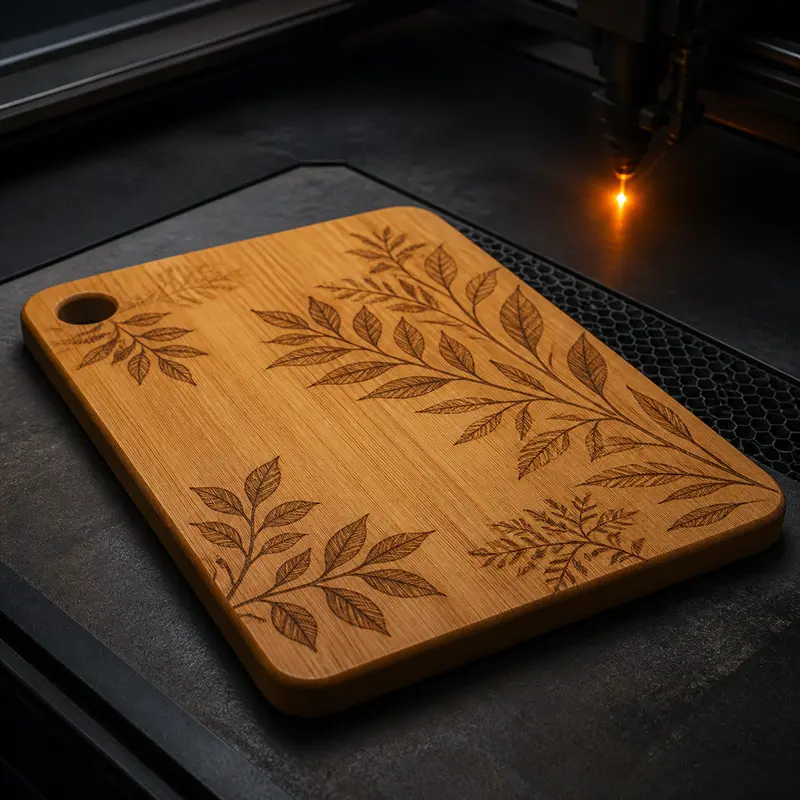
A bamboo cutting board is not one piece: it is strips glued together, and each strip can engrave a slightly different shade. Bamboo engraves well on a diode or CO2 laser — the harder questions are the glue and the face that touches food.
 Before you start With care
- Bamboo burns. It is a combustible organic material and should not be left unattended; stop if it separates or gives off unexpected smoke (Thunder Laser).
- Boards and bamboo plywood are glued. Glue lines change smoke, odour and residue, and laminates can delaminate under heat; ask the supplier how it is bonded (Thunder Laser). Some plywood glues release formaldehyde (what not to laser cut).
- Food contact. We found no source that tests laser-engraved cutting surfaces for food safety. The cautious choice is to engrave the back, the edge or a serving board, and keep the face you cut on smooth (general practice).
- Run your extraction (exhaust fan calculator) and wear goggles rated for your wavelength (safety glasses checker).
 What the beam does
Switch the material or laser and watch the same beam give a different result.
- Bamboo strips
- Glue lines
- Burn shade changes strip to strip
- Bamboo 5 mm
- Kerf through in one pass
- Oiled bamboo — darker
- Engraving, more even against the darker wood
The beam crosses several strips and glue lines. Each strip can burn a slightly different shade, and the glue lines can mark differently (Thunder Laser).
Cross-section, not to scale.
 Which laser can process it
These are this material’s rows from our diode vs CO2 vs fiber matrix. (full matrix)
Not suited: it scorches wood rather than marking it cleanly.
 Maker settings on one scale
Every value is a starting point published by the maker, and the maker is the source; none of them were tested by us. Machines differ in optical power, so power % and speed are converted to the energy the beam puts into each millimetre of line (J/mm). Tap a point or a table row to see the original row, the math and a link that fills in the converter.
This is the same formula as the converter. Between lasers of the same type, similar J/mm gives a similar burn. Cutting energy rises steeply with thickness, so compare rows of similar thickness.
AtomStack labels every row simply “Bamboo”, without saying whether it is solid, laminated or bamboo plywood. The cuts are 4–5 mm. The A40 Pro V2 LightBurn cut carries an S-value where a percentage belongs. The TwoTrees list we recorded has no bamboo row.
| Machine (optical W) | Software | Maker label · thickness | Job | Speed mm/min | Power | Interval | Passes | J/mm | |
|---|---|---|---|---|---|---|---|---|---|
| LightBurn | Bamboo | Engrave | 6,000 | 70% | 0.1 | 1 | 0.07 | Convert → | |
| LightBurn | Bamboo · 5mm | Cut | 150 | 80% | — | 1 | 3.2 | Convert → | |
| LaserGRBL | Bamboo | Engrave | 8,000 | S800 | 0.1 | 1 | 0.06 | Convert → | |
| LaserGRBL | Bamboo · 5mm | Cut | 150 | S1000 | — | 1 | 4 | Convert → | |
| LightBurn | Bamboo | Engrave | 3,000 | 80% | 0.1 | 1 | 0.32 | Convert → | |
| LightBurn | Bamboo · 5mm | Cut | 200 | 80% | — | 1 | 4.8 | Convert → | |
| LaserGRBL | Bamboo | Engrave | 3,000 | S800 | 0.1 | 1 | 0.32 | Convert → | |
| LaserGRBL | Bamboo · 5mm | Cut | 200 | S800 | — | 1 | 4.8 | Convert → | |
| LightBurn | Bamboo | Engrave | 20,000 | 80% | 0.1 | 1 | 0.0576 | Convert → | |
| LightBurn | Bamboo · 5mm | Cut | 400 | 80% | — | 1 | 2.88 | Convert → | |
| LaserGRBL | Bamboo | Engrave | 20,000 | S800 | 0.1 | 1 | 0.0576 | Convert → | |
| LaserGRBL | Bamboo · 5mm | Cut | 400 | S800 | — | 1 | 2.88 | Convert → | |
| LightBurn | Bamboo | Engrave | 10,000 | 55% | 0.1 | 1 | 0.158 | Convert → | |
| LightBurn | Bamboo · 5mm | Cut | 400 | S800 ? | — | 1 | 5.76 | Convert → | |
| LaserGRBL | Bamboo | Engrave | 10,000 | S800 | 0.1 | 1 | 0.23 | Convert → | |
| LaserGRBL | Bamboo · 5mm | Cut | 400 | S800 | — | 1 | 5.76 | Convert → | |
| LightBurn | Bamboo | Engrave | 10,000 | 45% | 0.1 | 1 | 0.189 | Convert → | |
| LightBurn | Bamboo · 5mm | Cut | 1,000 | 90% | — | 1 | 3.78 | Convert → | |
| LaserGRBL | Bamboo | Engrave | 10,000 | S450 | 0.1 | 1 | 0.189 | Convert → | |
| Bitmap | Bamboo | Engrave | 18,000 | 30% | 0.1 | 1 | 0.055 | Convert → | |
| Vector Line | Bamboo | Engrave | 3,000 | 8% | — | 1 | 0.088 | Convert → | |
| - | Bamboo · 4mm | Cut | 800 | 80% | — | 1 | 3.3 | Convert → | |
| - | Bamboo · 4mm | Cut | 1,000 | 100% | — | 1 | 3.3 | Convert → | |
| Bitmap | Bamboo | Engrave | 7,000 | 80% | 0.08 | 1 | 0.0343 | Convert → | |
| Vector Line | Bamboo | Engrave | 1,000 | 20% | — | 1 | 0.06 | Convert → | |
| Bitmap | Bamboo | Engrave | 15,000 | 80% | 0.1 | 1 | 0.064 | Convert → | |
| Vector Line | Bamboo | Engrave | 1,000 | 20% | — | 1 | 0.24 | Convert → | |
| - | Bamboo · 5mm | Cut | 250 | 80% | — | 1 | 3.84 | Convert → |
A bamboo board is strips and glue
Thunder Laser’s bamboo guide treats solid bamboo, laminated bamboo, bamboo plywood, veneer and coated bamboo as different materials. In a laminated board, strips can engrave at different shades, and glue lines can change the colour, the smoke and odour, and the edge. Sheets sold under the same name differ between makers and batches.
Our laser-type matrix has no separate bamboo row, so the wood row is shown above as the closest match. In the maker rows here, both diode and CO2 lasers engrave and cut bamboo.
Cutting boards and food contact
Keep it smooth — grooves are harder to clean
Engrave here; the cutting face stays smooth
Never used with food, so either face can carry the design. If food will sit on it, treat it like a cutting board.
- Pick the face. We found no test of laser-engraved cutting surfaces. General practice is to engrave the back, a handle or the edge, or to treat an engraved board as a serving or display board. Grooves on the cutting face are harder to clean.
- Clean and finish to suit. For cutting boards and other food-contact items, Thunder Laser advises a cleaning and finishing method suited to the use, following the product maker’s instructions; test a mild cleaner in a hidden spot and do not soak the bamboo (Thunder Laser).
- Oil. Food-grade mineral oil is the usual board oil (general practice). It darkens the bamboo, so try it on the back first.
- Coated boards. A lacquered or varnished board puts that coating under the beam too; find out what it is before you laser it (what not to laser cut).
Can you laser cut bamboo?
Yes, in thin stock. Every AtomStack diode with a bamboo cut row cuts 5 mm in one pass, and its 55 W CO2 cuts 4 mm. On the J/mm scale those cuts take about 2.9–5.8 J/mm (chart). Laminated bamboo and bamboo plywood may need different settings from solid bamboo of the same thickness (Thunder Laser), much like the glue story on the plywood & basswood page.
 How to run a bamboo test
Thunder Laser suggests changing one factor at a time — power, speed, line interval or passes — and notes that too much energy gives a rough texture and smoke staining.
- 1
Back of the board or an offcut from the same batch.
- 2
Grid across several strips so you see how far the shades spread (LightBurn).
- 3

One factor at a time (Thunder Laser).
- 4

Oil the test patch to see the final colour before you commit.
- 5
Pick the most even box at the lowest energy.
FAQ
- What are good laser settings for a bamboo cutting board?
- AtomStack’s diode bamboo fill (raster) engravings run 3,000–20,000 mm/min at 45–80 % power with a 0.08–0.1 mm interval, about 0.03–0.32 J/mm per line; its 55 W CO2 engraves at 18,000 mm/min and 30 %. Scale a row to your machine, test on the back of the board across several strips, and choose the most even box.
- Is a laser-engraved bamboo cutting board food safe?
- We found no study that tests it. Thunder Laser advises a cleaning and finishing method suited to food contact, following the board maker’s instructions. The cautious choice is to engrave the back, the edge or a serving board, keep the cutting face smooth, and clean the board before use.
- Can you laser cut bamboo?
- Yes, thin stock. AtomStack’s diodes cut 5 mm bamboo in one pass at 150–1,000 mm/min (about 2.9–5.8 J/mm), and its 55 W CO2 cuts 4 mm at 800–1,000 mm/min. Laminated bamboo and bamboo plywood can need different settings from solid bamboo.
- Why does my bamboo engraving look patchy?
- A bamboo board is many strips glued together, and each strip can engrave a slightly different shade; glue lines can mark differently too (Thunder Laser). Too much energy adds a rough texture and smoke staining. Lower the energy, test across several strips, and consider a finish to even out the tone.
Sources
- AtomStack, Material Setting (LightBurn, LaserGRBL and machine tables)
- Thunder Laser, Bamboo laser engraving and cutting: a practical guide (2026-05-28)
- Glowforge Support, Non-Proofgrade Materials FAQ
- MatEdU (NSF-funded), Materials for Laser Cutter Machines
- LightBurn documentation, Material Test
Sources for the laser-type verdicts
- xTool, Fiber vs CO2 vs Diode Laser: Differences Explained
- xTool Support, xTool F1 Product Introduction
- Atomm (xTool community), Materials for xTool S1
- Glowforge Aura (diode) product page
- Trotec, Diode vs CO2 vs fiber laser comparison guide
- OMTech, Diode vs CO2 vs Fiber Lasers
- Glowforge Performance Series tech specs (CO2)
- University of Georgia, Laser Cutter Materials List (CO2)
- University of Edinburgh uCreate, Laser Cutter Materials Guide (CO2)
- Rutgers Makerspace, Lasers (CO2 and MOPA fiber)
- xTool Support, Material Tests with the 1064 nm Infrared Module
- Boss Laser, fiber laser materials
Last checked 2026-11-02 · Maker values and calculations; we did not process this material ourselves.