Laser settings for wood: pine, maple, walnut and more
Solid wood has no glue lines, so the wood itself decides the result: density sets how much energy a cut takes, colour sets the contrast, and resin and knots decide how evenly it burns. Basswood has its own rows on the plywood page.
 Before you start Usually fine
- Wood burns. Keep air assist on, clear scraps and dust out of the machine, and never leave it while it runs; keep an extinguisher within easy reach (Trotec).
- Resin flares up. Resin-rich woods such as pine flare up more easily, and a few labs ban them (what not to laser cut). Resin varies within a board, especially around knots (Thunder Laser), and MatEdU warns that knots can flare up.
- Know what is on it. Treated, painted or coated lumber is not plain wood. If you cannot find out what the treatment or finish is, do not laser it.
- Run the exhaust. In a desktop CO2 test, carbon monoxide from wood reached 31.8 ppm inside the machine with the ventilation off and fell below detection with it on (O’Neill 2024). See the exhaust fan calculator.
 What the beam does
Switch the material or laser and watch the same beam give a different result.
- Maple — pale, fine grain
- Even dark burn
- Pale grain band
- Dark grain band
- Knot and resin
- Uneven burn
- Walnut — dark wood
- Burn: real but subtle
- Pine 15 mm
- Kerf after one slow pass
- Stops partway — makers use many fast passes
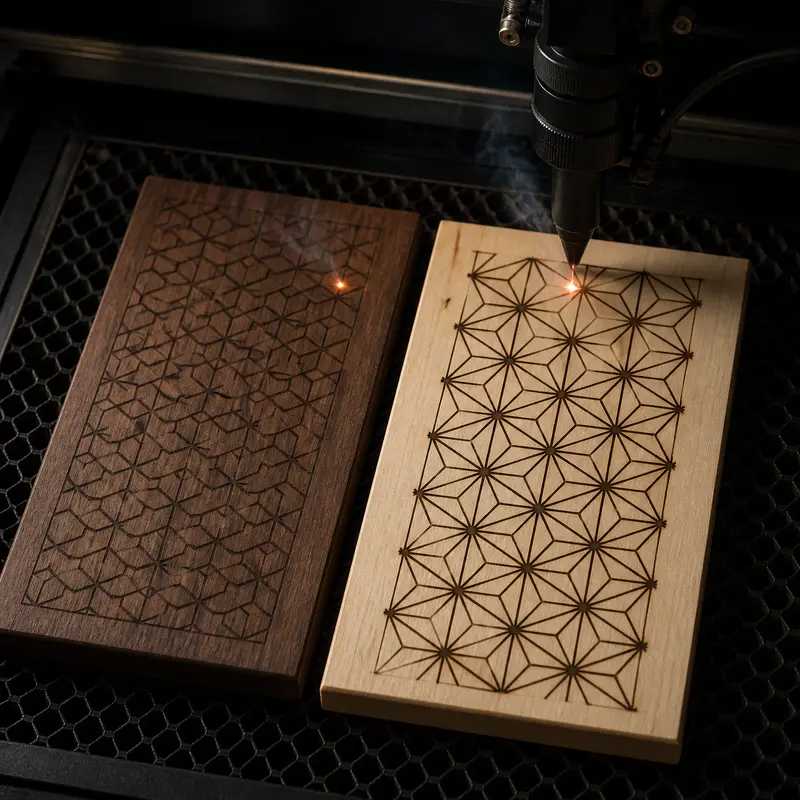
Pale, dense, fine-grained: the burn is even and dark against the light wood, so detail and contrast are strong. Maple may need more energy than soft wood (Thunder Laser).
Cross-section, not to scale.
 Which laser can process it
These are this material’s rows from our diode vs CO2 vs fiber matrix. (full matrix)
Not suited: it scorches wood rather than marking it cleanly.
 Maker settings on one scale
Every value is a starting point published by the maker, and the maker is the source; none of them were tested by us. Machines differ in optical power, so power % and speed are converted to the energy the beam puts into each millimetre of line (J/mm). Tap a point or a table row to see the original row, the math and a link that fills in the converter.
This is the same formula as the converter. Between lasers of the same type, similar J/mm gives a similar burn. Cutting energy rises steeply with thickness, so compare rows of similar thickness.
Rows are AtomStack’s Pine, Paulownia, Mahogany, Maple / Hard maple, Beech and “Yellow peach wood” / “peach wood” (the table does not say which species that is), plus TwoTrees’ 7 mm pine. AtomStack’s “Hardwood” rows exist only for machines whose optical power we could not confirm, so they are left out. Basswood rows are on the plywood page. Rows with 8–10 passes at a high speed are the maker’s thick-stock method, not typos. The A40 Pro V2 LightBurn cuts carry S-values where a percentage belongs.
| Machine (optical W) | Software | Maker label · thickness | Job | Speed mm/min | Power | Interval | Passes | J/mm | |
|---|---|---|---|---|---|---|---|---|---|
| LightBurn | Paulownia Wood | Engrave | 5,000 | 50% | 0.1 | 1 | 0.06 | Convert → | |
| LightBurn | Paulownia Wood · 12mm | Cut | 700 | 80% | — | 8 | 5.49 | Convert → | |
| LightBurn | Paulownia Wood · 8mm | Cut | 190 | 80% | — | 1 | 2.53 | Convert → | |
| LaserGRBL | Paulownia Wood | Engrave | 5,000 | S500 | 0.1 | 1 | 0.06 | Convert → | |
| LaserGRBL | Paulownia Wood · 12mm | Cut | 700 | S1000 | — | 8 | 6.86 | Convert → | |
| LaserGRBL | Paulownia Wood · 8mm | Cut | 190 | S1000 | — | 1 | 3.16 | Convert → | |
| LightBurn | Yellow Peach Wood | Engrave | 6,000 | 60% | 0.1 | 1 | 0.06 | Convert → | |
| LaserGRBL | Yellow Peach Wood | Engrave | 6,000 | S600 | 0.1 | 1 | 0.06 | Convert → | |
| LightBurn | Pine · 6mm | Cut | 100 | 80% ? | — | 10 | 48 | Convert → | |
| LightBurn | Pine · 10mm | Cut | 400 | 100% | — | 10 | 15 | Convert → | |
| LaserGRBL | Pine | Engrave | 6,000 | S800 | 0.0833 | 1 | 0.08 | Convert → | |
| LaserGRBL | Pine · 6mm | Cut | 100 | S1000 ? | — | 1 | 6 | Convert → | |
| LaserGRBL | Pine · 8mm | Cut | 400 | S1000 | — | 10 | 15 | Convert → | |
| LightBurn | Mahogany | Engrave | 6,000 | 60% | 0.08 | 1 | 0.06 | Convert → | |
| LaserGRBL | Mahogany | Engrave | 6,000 | S600 | 0.0833 | 1 | 0.06 | Convert → | |
| LightBurn | Paulownia Wood | Engrave | 20,000 | 80% | 0.1 | 1 | 0.048 | Convert → | |
| LightBurn | Paulownia Wood · 20mm | Cut | 20,000 | 80% ? | — | 10 | 0.48 | Convert → | |
| LightBurn | Paulownia Wood · 15mm | Cut | 150 | 100% | — | 1 | 8 | Convert → | |
| LaserGRBL | Paulownia Wood | Engrave | 20,000 | S800 | 0.1 | 1 | 0.048 | Convert → | |
| LaserGRBL | Paulownia Wood · 20mm | Cut | 800 | S800 | — | 10 | 12 | Convert → | |
| LaserGRBL | Paulownia Wood · 15mm | Cut | 150 | S1000 | — | 1 | 8 | Convert → | |
| LightBurn | Yellow Peach Wood | Engrave | 10,000 | 80% | 0.08 | 1 | 0.096 | Convert → | |
| LaserGRBL | Yellow Peach Wood | Engrave | 10,000 | 80% | 0.0833 | 1 | 0.096 | Convert → | |
| LightBurn | Pine | Engrave | 10,000 | 80% | 0.08 | 1 | 0.096 | Convert → | |
| LightBurn | Pine · 15mm | Cut | 500 | 80% | — | 10 | 19.2 | Convert → | |
| LightBurn | Pine · 12mm | Cut | 100 | 100% | — | 1 | 12 | Convert → | |
| LaserGRBL | Pine | Engrave | 10,000 | S800 | 0.0833 | 1 | 0.096 | Convert → | |
| LaserGRBL | Pine · 15mm | Cut | 500 | S800 | — | 10 | 19.2 | Convert → | |
| LaserGRBL | Pine · 12mm | Cut | 100 | S1000 | — | 1 | 12 | Convert → | |
| LightBurn | Mahogany | Engrave | 10,000 | 70% | 0.08 | 1 | 0.084 | Convert → | |
| LaserGRBL | Mahogany | Engrave | 10,000 | S700 | 0.0833 | 1 | 0.084 | Convert → | |
| LightBurn | Pine | Engrave | 15,000 | 80% | 0.1 | 1 | 0.0768 | Convert → | |
| LightBurn | Pine · 12mm | Cut | 100 | 80% | — | 1 | 11.5 | Convert → | |
| LightBurn | Pine · 18mm | Cut | 650 | 80% | — | 9 | 16 | Convert → | |
| LaserGRBL | Pine | Engrave | 15,000 | S800 | 0.1 | 1 | 0.0768 | Convert → | |
| LaserGRBL | Pine · 12mm | Cut | 100 | S800 | — | 1 | 11.5 | Convert → | |
| LaserGRBL | Pine · 18mm | Cut | 650 | S800 | — | 9 | 16 | Convert → | |
| LightBurn | peach wood | Engrave | 20,000 | 80% | 0.1 | 1 | 0.0576 | Convert → | |
| LaserGRBL | peach wood | Engrave | 20,000 | S800 | 0.1 | 1 | 0.0576 | Convert → | |
| LightBurn | Mahogany | Engrave | 30,000 | 80% | 0.1 | 1 | 0.0384 | Convert → | |
| LaserGRBL | Mahogany | Engrave | 30,000 | S800 | 0.1 | 1 | 0.0384 | Convert → | |
| LightBurn | Paulownia Wood | Engrave | 30,000 | 60% | 0.1 | 1 | 0.0288 | Convert → | |
| LightBurn | Paulownia Wood · 15mm | Cut | 200 | 80% | — | 1 | 5.76 | Convert → | |
| LightBurn | Paulownia Wood · 18mm | Cut | 1,000 | 80% | — | 8 | 9.22 | Convert → | |
| LaserGRBL | Paulownia Wood | Engrave | 30,000 | S800 | 0.1 | 1 | 0.0384 | Convert → | |
| LaserGRBL | Paulownia Wood · 15mm | Cut | 200 | S800 | — | 1 | 5.76 | Convert → | |
| LaserGRBL | Paulownia Wood · 18mm | Cut | 1,000 | S800 | — | 8 | 9.22 | Convert → | |
| LightBurn | maple | Engrave | 15,000 | 80% | 0.1 | 1 | 0.0768 | Convert → | |
| LaserGRBL | maple | Engrave | 15,000 | S800 | 0.1 | 1 | 0.0768 | Convert → | |
| LightBurn | Pine | Engrave | 15,000 | 80% | 0.1 | 1 | 0.0768 | Convert → | |
| LightBurn | Pine · 12mm | Cut | 100 | 80% | — | 1 | 11.5 | Convert → | |
| LightBurn | Pine · 18mm | Cut | 650 | 80% | — | 9 | 16 | Convert → | |
| LaserGRBL | Pine | Engrave | 15,000 | S800 | 0.1 | 1 | 0.0768 | Convert → | |
| LaserGRBL | Pine · 12mm | Cut | 100 | S800 | — | 1 | 11.5 | Convert → | |
| LaserGRBL | Pine · 18mm | Cut | 650 | S800 | — | 9 | 16 | Convert → | |
| LightBurn | peach wood | Engrave | 20,000 | 80% | 0.1 | 1 | 0.0576 | Convert → | |
| LaserGRBL | peach wood | Engrave | 20,000 | S800 | 0.1 | 1 | 0.0576 | Convert → | |
| LightBurn | Mahogany | Engrave | 30,000 | 80% | 0.1 | 1 | 0.0384 | Convert → | |
| LaserGRBL | Mahogany | Engrave | 30,000 | S800 | 0.1 | 1 | 0.0384 | Convert → | |
| LightBurn | Paulownia Wood | Engrave | 30,000 | 60% | 0.1 | 1 | 0.0288 | Convert → | |
| LightBurn | Paulownia Wood · 15mm | Cut | 200 | 80% | — | 1 | 5.76 | Convert → | |
| LightBurn | Paulownia Wood · 18mm | Cut | 1,000 | 80% | — | 8 | 9.22 | Convert → | |
| LaserGRBL | Paulownia Wood | Engrave | 30,000 | S800 | 0.1 | 1 | 0.0384 | Convert → | |
| LaserGRBL | Paulownia Wood · 15mm | Cut | 200 | S800 | — | 1 | 5.76 | Convert → | |
| LaserGRBL | Paulownia Wood · 18mm | Cut | 1,000 | S800 | — | 8 | 9.22 | Convert → | |
| LightBurn | maple | Engrave | 15,000 | 80% | 0.1 | 1 | 0.0768 | Convert → | |
| LaserGRBL | maple | Engrave | 15,000 | S800 | 0.1 | 1 | 0.0768 | Convert → | |
| LightBurn | Paulownia Wood · 20mm | Cut | 750 | S700 ? | — | 9 | 24.2 | Convert → | |
| LightBurn | Paulownia Wood · 14mm | Cut | 200 | S800 ? | — | 1 | 11.5 | Convert → | |
| LaserGRBL | Paulownia Wood | Engrave | 10,000 | 30% | 0.1 | 1 | 0.0864 | Convert → | |
| LaserGRBL | Paulownia Wood · 20mm | Cut | 750 | S700 | — | 9 | 24.2 | Convert → | |
| LaserGRBL | Paulownia Wood · 14mm | Cut | 200 | S800 | — | 1 | 11.5 | Convert → | |
| LightBurn | Yellow Peach Wood | Engrave | 10,000 | 50% | 0.1 | 1 | 0.144 | Convert → | |
| LaserGRBL | Yellow Peach Wood | Engrave | 10,000 | 50% | 0.1 | 1 | 0.144 | Convert → | |
| LightBurn | Pine · 15mm | Cut | 600 | S800 ? | — | 10 | 38.4 | Convert → | |
| LightBurn | Pine · 12mm | Cut | 100 | S800 ? | — | 1 | 23 | Convert → | |
| LaserGRBL | Pine | Engrave | 10,000 | 50% | 0.1 | 1 | 0.144 | Convert → | |
| LaserGRBL | Pine · 15mm | Cut | 600 | S800 | — | 10 | 38.4 | Convert → | |
| LaserGRBL | Pine · 12mm | Cut | 100 | S800 | — | 1 | 23 | Convert → | |
| LightBurn | Yellow peach wood | Engrave | 10,000 | 40% | 0.1 | 1 | 0.168 | Convert → | |
| LaserGRBL | Yellow peach wood | Engrave | 10,000 | S400 | 0.1 | 1 | 0.168 | Convert → | |
| LightBurn | Pine | Engrave | 10,000 | 40% | 0.1 | 1 | 0.168 | Convert → | |
| LightBurn | Pine · 25 | Cut | 1,100 | 90% | — | 10 | 34.4 | Convert → | |
| LightBurn | Pine · 20 | Cut | 120 | 90% | — | 1 | 31.5 | Convert → | |
| LaserGRBL | Pine | Engrave | 10,000 | S400 | 0.1 | 1 | 0.168 | Convert → | |
| LaserGRBL | Pine · 25 | Cut | 1,100 | S900 | — | 10 | 34.4 | Convert → | |
| LaserGRBL | Pine · 20 | Cut | 120 | S900 | — | 1 | 31.5 | Convert → | |
| LightBurn | Paulownia Wood | Engrave | 10,000 | 25% | 0.1 | 1 | 0.105 | Convert → | |
| LightBurn | Paulownia Wood · 20 | Cut | 800 | 90% | — | 2 | 9.45 | Convert → | |
| LightBurn | Paulownia Wood · 18 | Cut | 350 | 90% | — | 1 | 10.8 | Convert → | |
| LaserGRBL | Paulownia Wood | Engrave | 10,000 | S250 | 0.1 | 1 | 0.105 | Convert → | |
| LaserGRBL | Paulownia Wood · 20 | Cut | 800 | S900 | — | 2 | 9.45 | Convert → | |
| LaserGRBL | Paulownia Wood · 18 | Cut | 350 | S900 | — | 1 | 10.8 | Convert → | |
| LightBurn | Hard maple | Engrave | 10,000 | 60% | 0.08 | 1 | 0.252 | Convert → | |
| LaserGRBL | Hard maple | Engrave | 10,000 | S600 | 0.0833 | 1 | 0.252 | Convert → | |
| Bitmap | Yellow peach wood | Engrave | 18,000 | 20% | 0.1 | 1 | 0.0367 | Convert → | |
| Vector Line | Yellow peach wood | Engrave | 3,000 | 5% | — | 1 | 0.055 | Convert → | |
| Bitmap | Pine | Engrave | 18,000 | 20% | 0.1 | 1 | 0.0367 | Convert → | |
| Vector Line | Pine | Engrave | 3,500 | 5% | — | 1 | 0.0471 | Convert → | |
| - | Pine · 14mm | Cut | 100 | 80% | — | 1 | 26.4 | Convert → | |
| - | Pine · 15mm | Cut | 100 | 100% | — | 1 | 33 | Convert → | |
| Bitmap | Paulownia wood | Engrave | 15,000 | 45% | 0.1 | 1 | 0.099 | Convert → | |
| Vector Line | Paulownia wood | Engrave | 3,500 | 6% | — | 1 | 0.0566 | Convert → | |
| - | Paulownia wood · 18mm | Cut | 200 | 100% | — | 1 | 16.5 | Convert → | |
| - | Paulownia wood · 14mm | Cut | 300 | 80% | — | 1 | 8.8 | Convert → | |
| - | Paulownia wood · 18mm | Cut | 400 | 80% | — | 2 | 13.2 | Convert → | |
| Bitmap | Yellow peach wood | Engrave | 8,000 | 80% | 0.08 | 1 | 0.03 | Convert → | |
| Vector Line | Yellow peach wood | Engrave | 1,000 | 15% | — | 1 | 0.045 | Convert → | |
| Bitmap | Pine | Engrave | 5,000 | 80% | 0.08 | 1 | 0.048 | Convert → | |
| Vector Line | Pine | Engrave | 1,000 | 30% | — | 1 | 0.09 | Convert → | |
| Bitmap | Paulownia wood | Engrave | 8,000 | 80% | 0.08 | 1 | 0.03 | Convert → | |
| Vector Line | Paulownia wood | Engrave | 1,000 | 15% | — | 1 | 0.045 | Convert → | |
| Bitmap | Beech | Engrave | 8,000 | 80% | 0.08 | 1 | 0.03 | Convert → | |
| Vector Line | Beech | Engrave | 1,000 | 20% | — | 1 | 0.06 | Convert → | |
| LightBurn | Pine · 4mm | Cut | 100 | 80% | — | 2 | 4.8 | Convert → | |
| LightBurn | Paulownia wood · 4mm | Cut | 150 | 80% | — | 1 | 1.6 | Convert → | |
| LightBurn | Paulownia wood · 7mm | Cut | 150 | 80% | — | 3 | 4.8 | Convert → | |
| Bitmap | Pine | Engrave | 10,000 | 80% | 0.1 | 1 | 0.096 | Convert → | |
| Vector Line | Pine | Engrave | 1,000 | 15% | — | 1 | 0.18 | Convert → | |
| - | Pine · 8mm | Cut | 100 | 80% | — | 1 | 9.6 | Convert → | |
| - | Pine · 12mm | Cut | 300 | 80% | — | 10 | 32 | Convert → | |
| Bitmap | peach wood | Engrave | 20,000 | 80% | 0.1 | 1 | 0.048 | Convert → | |
| Vector Line | peach wood | Engrave | 1,000 | 10% | — | 1 | 0.12 | Convert → | |
| Bitmap | Mahogany | Engrave | 15,000 | 80% | 0.1 | 1 | 0.064 | Convert → | |
| Vector Line | Mahogany | Engrave | 500 | 8% | — | 1 | 0.192 | Convert → | |
| Bitmap | Paulownia Wood | Engrave | 25,000 | 80% | 0.1 | 1 | 0.0384 | Convert → | |
| Vector Line | Paulownia Wood | Engrave | 1,000 | 30% | — | 1 | 0.36 | Convert → | |
| - | Paulownia wood · 10mm | Cut | 100 | 80% | — | 1 | 9.6 | Convert → | |
| - | Paulownia wood · 13mm | Cut | 850 | 80% | — | 10 | 11.3 | Convert → | |
| - | Pine 7.0 mm · 7mm | Cut | 100 | 100% | — | 2 | 6.6 | Convert → | |
| - | Pine 7.0 mm · 7mm | Cut | 150 | 100% | — | 1 | 4 | Convert → |
Which wood engraves best
Strongest contrast, fine detail; may need more energy
Dark burn on dark wood: subtle
Open grain: more textured
May darken over time
Grain variation, knots, resin: uneven
Light; cuts on less energy (maker rows)
Thunder Laser’s wood guide sums up what changes between species. Light woods such as maple, birch and basswood give the strongest contrast; dark woods such as walnut give a subtler result. Fine-grained maple and birch suit small text and photos; open-grain oak and ash look more textured. Pine has strong grain variation and knots. Cherry may darken over time. Denser woods need more energy or slower speeds.
Basswood is the usual laser sheet, but AtomStack’s Basswood rows are on the plywood & basswood page, next to the glue question that decides plywood cuts.
 Pine vs paulownia: energy per millimetre of cut
Divide a cut row’s J/mm by its thickness and you get the energy each millimetre of wood needed. Take every machine where AtomStack lists a one-pass cut for both pine and paulownia (the light wood called kiri in Japan): paulownia needed about a third to half the energy per millimetre on six of them, and 0.8 times on the Kraft. That is a calculation on the maker’s own rows, not a test — but it is why paulownia shows up in the tables at greater thickness and higher speed than pine on the same machine. For how thick each wattage cuts, see how thick can a laser cut.
 Pine, resin and knots
- Resin — sources split on which woods. Thunder Laser says pine and cedar carry more resin than maple, birch, cherry or alder, and that resin varies within a board, especially around knots (Thunder Laser). MatEdU instead names cherry and alder as higher-resin woods that burn to deeper tones and are more likely to catch fire (MatEdU). Either way, resin means more smoke and residue — test your own board.
- Knots. MatEdU says knots are harder to cut, can stop a cut going through, and can flare up, scorching and darkening the surface. Keep air assist on and stay at the machine.
- Uneven tone. Grain variation and knots give dark patches and uneven fine detail (Thunder Laser). Put a test across a knot, not only on clear wood.
- Engraving rows. AtomStack’s diode pine fill (raster) engravings run 5,000–15,000 mm/min at 40–80 % with a 0.08–0.1 mm interval, about 0.05–0.17 J/mm per line.
 Prep and finish
Low-tack laser masking on the face
Smoke residue lands on the tape
Clean edges; wipe what is left
- Mask the face. Low-tack laser masking reduces smoke staining, but its adhesive may affect oily, rough or delicate surfaces — test it first (Thunder Laser). Epilog also suggests masking wood (Epilog FAQ).
- Clean the residue with a citrus cleaner or a mild household cleaner, as Epilog suggests.
- Check flatness. Solid boards cup and twist; focus on the top face and check the corners on a big board (general practice).
- Joints and fit: the kerf & joint-fit calculator sizes slots for your kerf.
 How to run a wood test
Test on the exact board you will use: species, cut and the knots in it all change the result (Thunder Laser recommends testing on the exact sample).
- 1
Offcut of the same board, including a knot if the board has one.
- 2
Grid power against speed (LightBurn, or our material test grid generator).
- 3
Centre it on a maker row for the same species, scaled with the power & speed converter.
- 4
For cuts, fix power and speed and add passes until a small square drops out.
- 5
Pick the most even box, not the darkest.
FAQ
- What are good laser settings for wood?
- It depends on the species and your machine. AtomStack’s diode fill (raster) engraving rows for pine, paulownia, mahogany, maple, beech and peach wood run 5,000–30,000 mm/min at 25–80 % power with a 0.08–0.1 mm interval — about 0.03–0.25 J/mm per line. Scale a row for the same species to your machine with the converter, then run a test grid.
- What are good laser engraving settings for pine?
- AtomStack’s diode pine fill (raster) engravings run 5,000–15,000 mm/min at 40–80 % with a 0.08–0.1 mm interval, about 0.05–0.17 J/mm per line; its 55 W CO2 engraves pine at 18,000 mm/min and 20 %. Pine’s grain and knots burn unevenly, so pick the most even box from a test that crosses a knot.
- What is the best wood for laser engraving?
- For contrast and detail, light fine-grained woods such as maple, birch and basswood. Walnut gives a subtler, darker result, open-grain oak and ash look textured, and pine is the least even because of grain variation, knots and resin (Thunder Laser).
- How thick can a diode laser cut solid wood?
- In AtomStack’s tables, the A20 Pro V2 (20 W) and A24 Pro / A24 Ultra (24 W) cut 12 mm pine and 15 mm paulownia in one slow pass (100–200 mm/min); the 20 W Kraft’s one-pass rows are 8 mm pine and 10 mm paulownia; and the 70 W A70 Max cuts 20 mm pine in one pass and 25 mm in 10 fast passes. These are maker values for their machines; see our “how thick can a laser cut” guide for every wattage.
Sources
- AtomStack, Material Setting (LightBurn, LaserGRBL and machine tables)
- TwoTrees, Laser Engraver Material Test List
- Thunder Laser, Best wood for laser engraving and cutting: a STEAM educator’s guide (2024-08-03)
- MatEdU (NSF-funded), Materials for Laser Cutter Machines
- Epilog Laser blog, Top 10 frequently asked laser questions
- O’Neill K, Niu X, Wang J, Fang R. Respirable particles and gas contaminants emissions from a desktop laser cutter and engraver. Aerosol and Air Quality Research 2024;24(8):240032
- Trotec blog (Nadine Schall), Is laser cutting a fire hazard? (2024-09-09)
- LightBurn documentation, Material Test
Sources for the laser-type verdicts
- xTool, Fiber vs CO2 vs Diode Laser: Differences Explained
- xTool Support, xTool F1 Product Introduction
- Atomm (xTool community), Materials for xTool S1
- Glowforge Aura (diode) product page
- Trotec, Diode vs CO2 vs fiber laser comparison guide
- OMTech, Diode vs CO2 vs Fiber Lasers
- Glowforge Performance Series tech specs (CO2)
- University of Georgia, Laser Cutter Materials List (CO2)
- University of Edinburgh uCreate, Laser Cutter Materials Guide (CO2)
- Rutgers Makerspace, Lasers (CO2 and MOPA fiber)
- xTool Support, Material Tests with the 1064 nm Infrared Module
- Boss Laser, fiber laser materials
Last checked 2026-11-02 · Maker values and calculations; we did not process this material ourselves.