Upcut vs downcut vs compression bits
The spiral decides which way the chips go and which face of the board stays clean. Pick your material and job for the bit to use, then drag the depth knob and watch a compression bit fray the top edge until its first pass clears the upcut part.
 The short answer
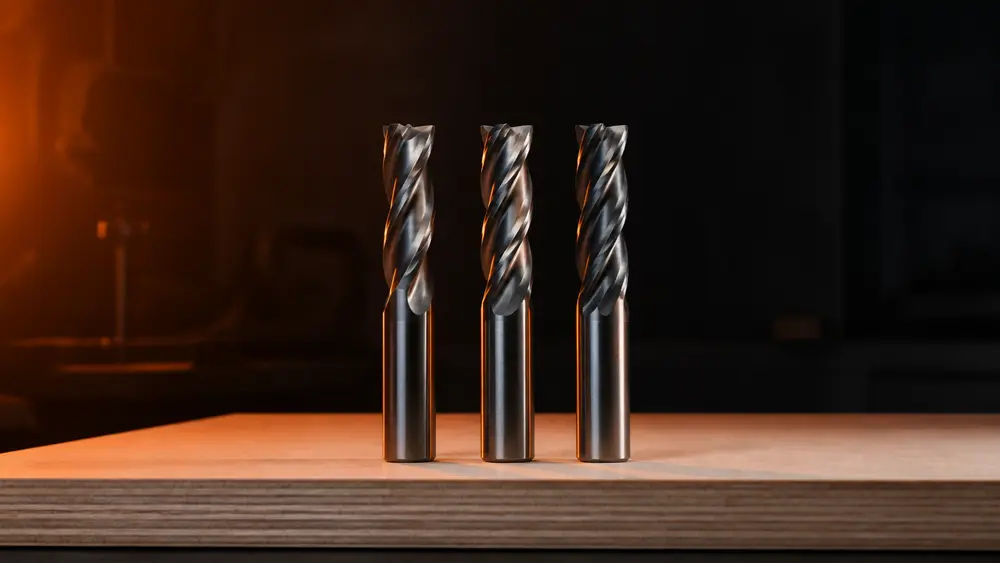
Upcut flutes lift chips out: clean bottom face, fuzzy top edge, part pulled up. Downcut flutes push down: crisp top edge, fuzzy bottom on a through cut, chips packed into blind cuts. A compression bit is upcut at the tip and downcut above, so both faces of a through cut stay clean — if the first pass goes deeper than the upcut part (ToolsToday, AXYZ, Stepcraft).
Upcut
- Clean
- bottom face
- Frays
- top face
- Chips
- up and out
- Part
- pulled up
Downcut
- Clean
- top face
- Frays
- bottom face
- Chips
- pushed into the cut
- Part
- pressed down
Compression
- Clean
- both faces
- If
- first pass > upcut part
- Chips
- meet at the change
- Part
- pulled and pressed
The same 12 mm plywood cut through by each bit, drawn to scale. Blue arrows: chips going up; orange: chips pushed down. Fuzz shows on the face the flutes lift; the dashed line on the compression bit is its spiral change.
 Pick the material and the job
Plywood, MDF, hardwood, acrylic or aluminum; a cut-out, pocket, groove or mortise. The card says which bit and why, with the source for each reason. Below it, the board is cut in section: the flutes spin, chips stream up or down, and the edges fray where the flutes lift the fibres.
1Your material and job
Compression spiral
Why
- Plywood’s faces are thin veneer, and that is what chips out at the edge of a cut.
- A compression bit has upcut flutes at the tip and downcut flutes above, so both faces of a through cut stay clean (ToolsToday, Whiteside).
- Only if the first pass goes deeper than the upcut part. Any shallower and it cuts like a plain upcut bit (Stepcraft, Yeti Tool).
Second choice: Machine can’t take a first pass that deep? ToolsToday suggests an upcut or downcut bit for profile cuts instead. Which one is our call from which face each leaves clean: a downcut when the top face shows, an upcut when the back face shows.
The cross-section below now shows this bit. Change the bit or the depth and watch the edges and the chips.
2Try another bit
3Board and pass
 Why the spiral decides which face is clean
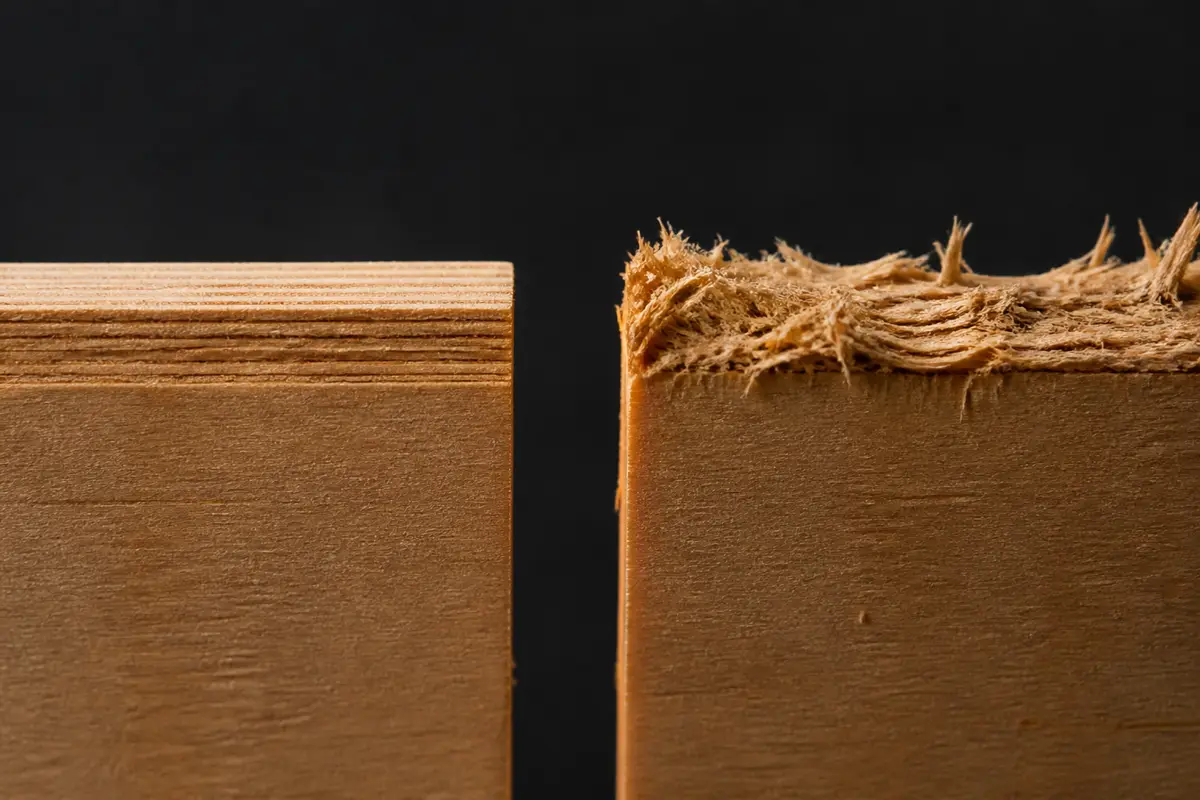
A spiral flute is a ramp. As the bit spins, an upcut ramp carries whatever it cuts upward — chips out of the slot, but also the surface fibres at the top edge, which lift and fray. ToolsToday describes upcut bits as pulling the fibres “up and out of the cut”, and AXYZ, which builds CNC routers, calls them the most popular spiral tool because they clear chips fast and leave the best finish on the bottom face. The same ramp pulls on the part itself: CNCCookbook notes that upcuts pull up on the workpiece, so thin or loose stock needs tabs, screws or a vacuum table.
A downcut ramp runs the other way. It presses the top fibres down into the cut, so the top edge stays crisp and the sheet is pushed onto the bed — AXYZ recommends downcuts for material 1/8" (3.175 mm) or thinner. The price is the chips: they are pushed back into the cut, so on a through cut the bottom fibres are forced out and fray, and in a blind cut the chips pack, get re-cut and heat the bit (ToolsToday). AXYZ and CNCCookbook both say downcuts are usually fed a little slower.
| Bit | Clean face | Frays | Chips | Part | Good for |
|---|---|---|---|---|---|
| Upcut | Bottom | Top | Up and out | Pulled up | Deep cuts, thick hardwood, plastics and aluminum (O-flute) |
| Downcut | Top | Bottom (through cuts) | Pushed into the cut | Pressed down | Shallow pockets, grooves, thin sheet |
| Compression | Both | Top, if the first pass is too shallow | Meet at the spiral change | Pulled at the tip, pressed by the body | Through cuts in plywood, MDF, melamine |
| Mortise compression | Top (short upcut) | — | Mostly down | Mostly pressed | Dados, mortises, shallow through cuts |
Everything on this page assumes the usual spindle, turning clockwise seen from above (right-hand rotation). Left-hand (counter-clockwise) router bits exist, but CNCCookbook notes that 95 % of downcut router bits are right-hand rotation. Spec sheets do not always say upcut or downcut, either; some give the helix and cut direction instead, as the retailer description of Amana’s aluminum O-flute upcut does (right-hand helix, right-hand cut). Go by the up/down label and your spindle’s rotation together.
Wood is where the difference shows. Acrylic and aluminum have no fibres to lift, so for them the spiral matters for where the chips go, which is the next problem: heat.
 Compression bits: the first pass has to clear the upcut
The upcut part of a compression bit runs from the tip to the spiral change. Until the tip is deeper than that, only upcut flutes touch the top face. Stepcraft, which makes CNC machines, put it plainly: if you don’t plunge past the spiral change, the bit “will act the same as an up-cut end mill”. Yeti Tool says a stepdown shorter than the upcut length leaves the downcut section short of the surface, “and you will experience tearout”.
| Bit | First pass deeper than | First pass ÷ D | Feed at that depth | Source |
|---|---|---|---|---|
| Amana 46180 · 1/8" · upcut 7/32" (5.56 mm) | 5.56 mm | 1.75 × D | 81 % | Stepcraft |
| Amana 46170 · 1/4" · upcut 1/4" (6.35 mm) | 6.35 mm | 1 × D | 100 % | Burns Tools listing, cutter height (B1) 1/4" |
| Short upcut (mortise style) · 1/4" · 4 mm | 4 mm | 0.63 × D | 100 % | Yeti Tool suggests 4 mm and below |
The feed column uses the depth factors printed on Amana’s and Onsrud’s charts (we draw a straight line between 1, 2 and 3 × D). It shows why small bits are the hard case. Amana’s 1/8" 46180 has its spiral change 7/32" up, so the first pass must be about 1.75 times the bit diameter; Stepcraft ran it at 0.22" first, then 1/8" passes, with the last pass about 0.030" past the material. Amana’s 1/4" 46170, with a 1/4" upcut part, needs only 1 × D. That is the gap behind ToolsToday’s warning that small hobby machines may not manage the deep first pass — and why Yeti Tool prefers short upcut sections of 4 mm and below, since a bigger stepdown needs a slower feed and can burn the wood.
For the 46170 we use the 1/4" cutter height (B1) on the Burns Tools listing as the upcut part, the dimension Stepcraft gives as the spiral change on the 46180. Check the spec sheet of your exact bit, or measure from the tip to where the flutes change direction. The feed factor also applies to every later pass: one 12.4 mm pass with a 1/4" bit is 1.95 × D, about 76 % of the chart feed. Work out the feed for each depth in the CNC chipload calculator.
 Packed chips, heat and melted plastic
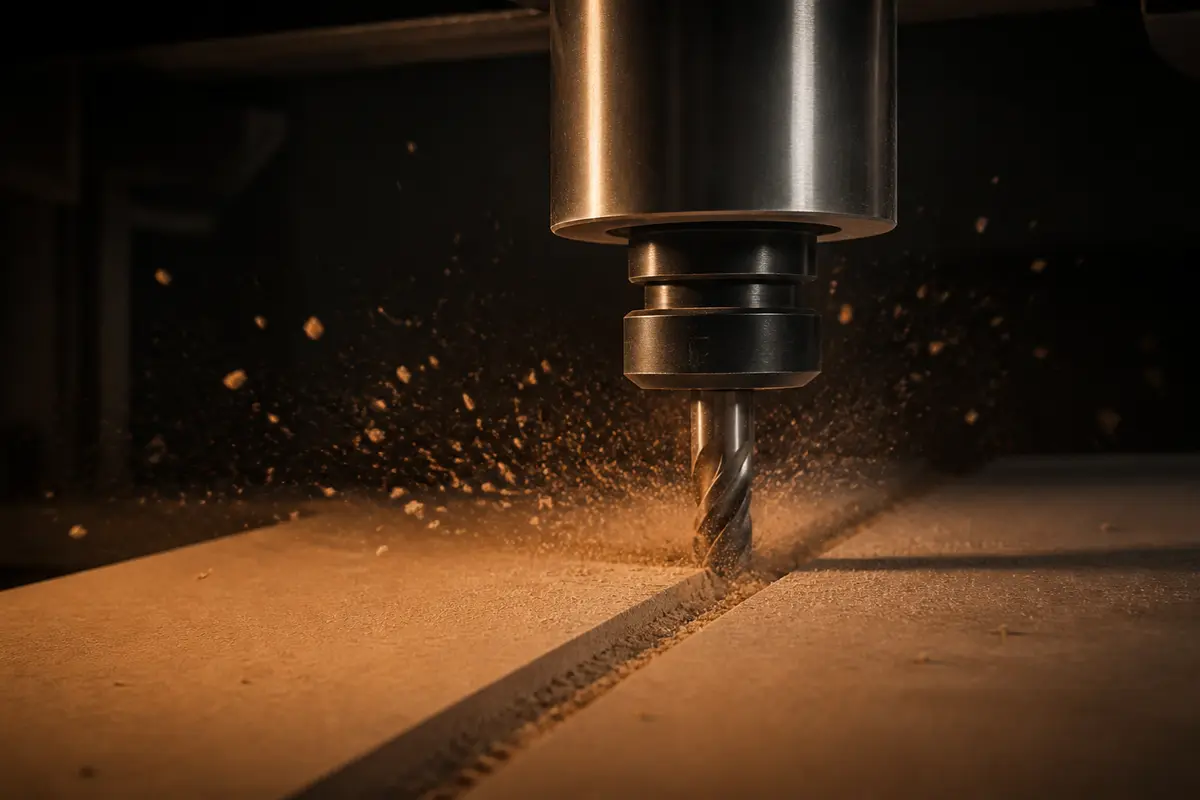
Every chip that stays in the cut gets hit again. ToolsToday’s explanation of downcuts is that on deep profiles the chips are not evacuated, get recut, and cause heat and bit wear; upcuts give the most chip evacuation, which reduces heat and allows a higher feed. In wood that heat shows as burn marks and dull bits. In plastic it softens the edge, which is why plastic and aluminum tooling is built around clearing chips. ToolsToday says single-flute and O-flute bits are often used for plastics and aluminum because they leave more room for chip evacuation and help reduce heat in materials that melt or weld easily; Amana’s plastic and aluminum feed charts are for single O-flute bits, in up-cut and down-cut versions; and Harvey Tool sells its plastic end mills as high-helix upcuts (about 40°) for faster chip removal. For a deep or blind cut in plastic or aluminum, that makes a single O-flute upcut the usual pick.
So the downcut’s crisp top edge has a depth limit. Keep downcut passes shallow in pockets and grooves, and switch to an upcut once the cut is deep enough that the chips have nowhere to go. A compression bit sits between the two: its chips meet near the spiral change and stay in the kerf until the bit moves on. Burning can also come from chips that are too thin, when the spindle is fast and the machine slow; the chipload calculator checks that.
 Flutes and helix angle
Flute count. ToolsToday says that at the same rpm and feed a single-flute bit takes a larger chip per flute than a 2-flute bit; by the chip-load formula (feed ÷ (rpm × flutes)) it is twice as thick. One flute also leaves the biggest gullet for the chips to sit in. That is why single O-flute bits fill Amana’s plastic and aluminum charts, and why they help a hobby router that cannot slow its spindle. Two flutes trade some chip room for balance and stiffness — Harvey Tool says its 2-flute design “improves rigidity for better accuracy, less deflection, and longer tool life”. Compression bits are sold as 1+1 (one up, one down: Whiteside’s UD4125) or 2+2 and similar.
Helix angle. The helix angle is measured from the bit’s axis, so the larger it is, the flatter the flutes lie, and the harder they pull. Harvey Tool lists about 40° for its high-helix plastic end mills, for faster chip removal and a better finish, and says a slow-helix upcut “reduces lifting forces”, which suits vacuum tables. We found no maker giving helix angles for the common hobby wood bits, so treat the drawing as an illustration, not a number to shop by.
 End mill types and their uses
Square (flat) end mill
Profiles, pockets and flat-bottomed slots. Comes as upcut, downcut or compression.
Ball nose
A round tip for 3D carving and finishing passes; the stepover sets the scallop height.
Scallop calculator →V-bit
V-carving, lettering, chamfers and signs. Depth = (width ÷ 2) ÷ tan(angle ÷ 2).
V-bit depth calculator →O-flute (single flute)
One open flute, often used for plastics and aluminum (ToolsToday). Amana’s plastic and aluminum charts are for these bits, in up-cut and down-cut versions.
Surfacing bit
A wide, short cutter for flattening a spoilboard or a slab (CNCCookbook).
Chipbreaker / rougher
Serrated edges break the chips small for fast roughing; the wall is left rougher (CNCCookbook).
The upcut, downcut and compression question applies to the square end mills that do most of the cutting on a hobby CNC. For V-carving depths and ball-nose stepovers, use the V-bit depth and scallop calculator. Coatings are sold on tool life; Amana’s aluminum O-flute 51402-Z, for example, is listed as ZrN-coated on Woodcraft. We found no independent test comparing coated and plain bits on hobby machines.
 Before the first cut
- Find the upcut lengthOn the spec sheet (“up-cut height”), or measure from the tip to where the flutes change direction. Amana 46180: 7/32" (5.56 mm).
- Make the first pass deeperPast the spiral change, then normal passes. Cut the feed by the depth factor for that first pass.
 Hold the part downUpcuts pull the part up and cut-outs come loose at the end: tabs, screws, clamps or vacuum.
- Watch the chipsChips, not dust, and none packed in a blind cut. Packed chips are re-cut and heat the bit.
- Test in scrapCut a short test in the same sheet and look at both faces before the real part.
FAQ
- What is the difference between upcut and downcut bits?
- The direction of the spiral. Upcut flutes lift the chips up and out of the cut, which keeps the cut cool and leaves a clean bottom face, but the top edge can fray and the part is pulled up. Downcut flutes push the fibres and chips down, which leaves a crisp top edge and presses the part onto the bed, but the bottom of a through cut frays and chips pack into a blind cut (ToolsToday, AXYZ).
- When should I use a compression bit?
- For through cuts in sheet goods where both faces show: veneered plywood, melamine, laminates and MDF. The tip is upcut and the body downcut, so both edges stay clean, but only when the first pass goes deeper than the upcut part — more than 7/32" (5.56 mm) for Amana’s 1/8" 46180 (Stepcraft). In a shallow pocket the downcut part never reaches the surface, and ToolsToday advises against it there.
- Why does my compression bit still leave a fuzzy top edge?
- Almost always the first pass was shallower than the upcut part, so only upcut flutes touched the surface and the bit cut like an upcut (Stepcraft, Yeti Tool). Make the first pass deeper than the spiral change, or use a mortise-style bit with a short upcut. If the upcut part is as long as the board is thick or longer, the downcut flutes reach the top face only when the pass goes into the spoilboard by more than the difference, which is a sign to use a shorter upcut.
- Which bit should I use for acrylic and aluminum?
- A single O-flute, usually an upcut. ToolsToday says single-flute and O-flute bits are often used for plastics and aluminum because they leave more room for chips and help reduce heat in materials that melt or weld, and that upcuts clear chips best; Harvey Tool’s plastic end mills are high-helix upcuts. Amana’s plastic and aluminum charts cover single O-flutes in both up-cut and down-cut versions, so for thin sheet that lifts off the bed a down-cut O-flute (Amana 51504 for plastic, 51502 for aluminum) presses it down; AXYZ recommends downcuts for 1/8" (3.175 mm) or thinner. CNCCookbook says compression bits are not for metal.
Sources
- ToolsToday (Matt Plumlee, 2023): Downcut, upcut & compression bits
- Stepcraft USA (Erick Royer, 2018): The correct way to set up a compression end mill
- Yeti Tool knowledge base (2024): Using compression cutters correctly
- AXYZ: The difference between upcut and downcut CNC router bits
- Whiteside Machine: UD4125 up/down cut spiral (1+1 compression)
- Harvey Tool: End mills for plastics, square upcut, 2 flute, high helix
- Burns Tools: Amana 46170 1/4" compression spiral (listing)
- Woodworker’s Journal (2011): Amana CNC compression spiral bits
- Amana Tool: plastic cutting spiral single O flute chart (v9; up-cut and down-cut numbers)
- Amana Tool: aluminum cutting spiral single O flute chart (v9; up-cut and down-cut numbers)
- Woodcraft: Amana 51402-Z single O-flute aluminum up-cut (listing)
- Amana Tool: Spektra 2-flute spiral chart (depth factors)
- Onsrud Cutter: MDF cutting data (depth factors)
- ToolsToday: Understanding CNC feeds and speeds (single-flute and O-flute bits for plastics and aluminum)
- CNCCookbook: CNC router bits (rotation; compression bits not for metal)
- WOODWEB knowledge base forum answers (2005): Upcut, downcut or compression tools
Last checked 2026-11-02 · Built from tool makers’ and CNC makers’ published guidance and calculated from their charts; no CNC machine was used to make this page. More calculators are on the tools page.